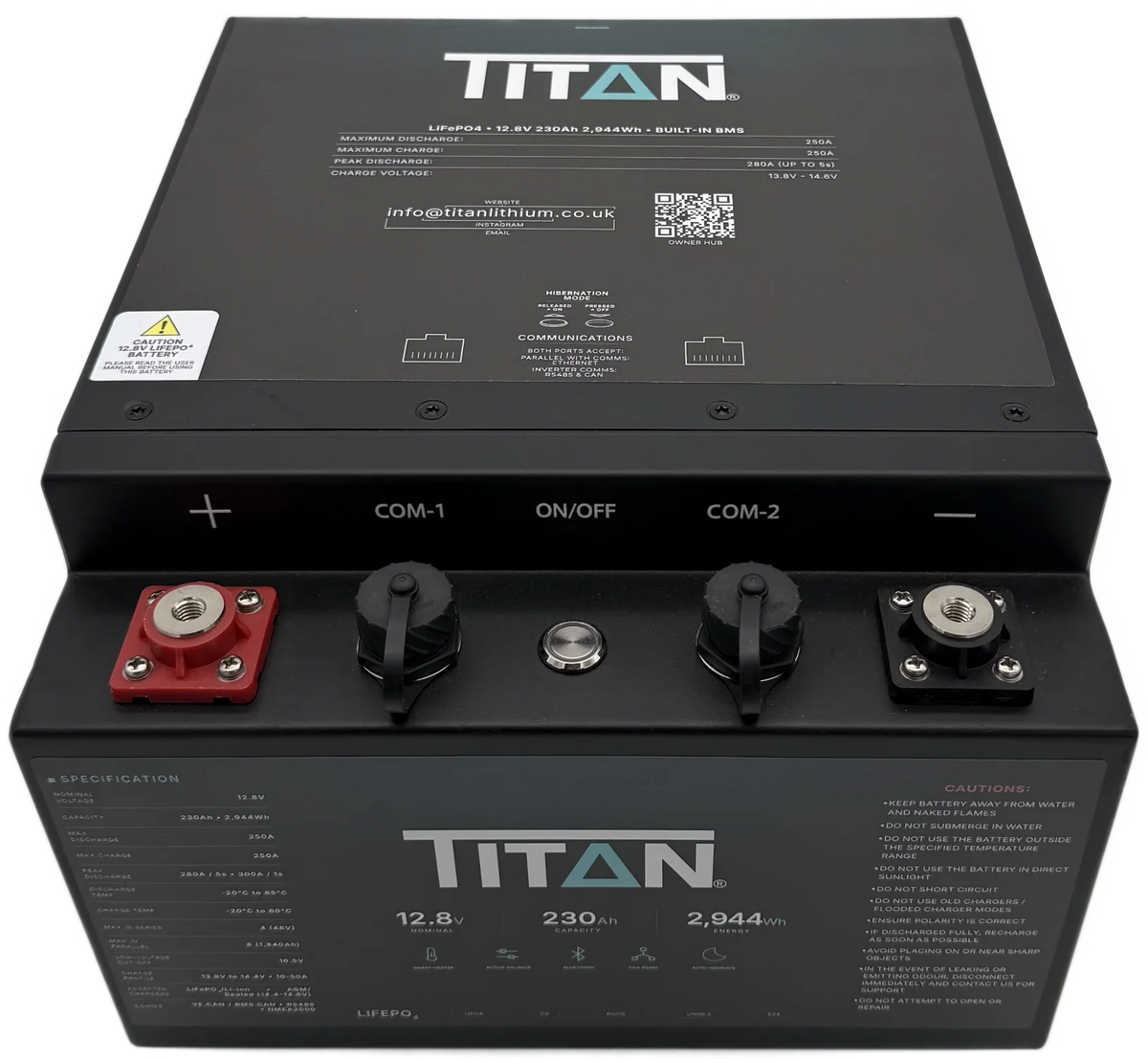
Titan 12v lithium iron phosphate (LiFePO₄) underseat leisure battery 230Ah
Titan 12v lithium iron phosphate (LiFePO₄) underseat leisure battery 230Ah
 Get this item on:
loading... - loading...
Get this item on:
loading... - loading...
Couldn't load pickup availability
Titan 12v lithium iron phosphate (LiFePO₄) underseat leisure battery 230Ah
12.8V | 230Ah | 2,944Wh
Real achievable capacity - up to 245Ah
315mm long x 280mm wide x 188mm high
The answer to the under-seat battery. 2,944Wh of real, usable energy at 12.8V, packed into a low, wide metal case that fits in the space nobody else can use: under a driver or passenger seat base, under a bench seat, in a low locker or beneath a bed frame. 188mm tall, so it clears seat boxes and locker lids that a taller industrial pack never could, and every connection is on the front face so it can sit hard against a wall on three sides.
- 2,944Wh usable, up to 245Ah in practice
- 250A continuous BMS discharge, 300A peak
- 188mm tall - fits where a standard tall pack will not
- All connections on the front face: M8 terminals, two comms ports, built-in on/off
- Metal case, 25kg
- Native Victron canbus
- Built-in heater mat, safe charging down to -30°C
- Lifetime, transferable warranty
Happy mounted on its base, on its side or on its end, just not inverted (upside down). Free tie-down strap kit included with every metal-cased battery.
The cell chemistry
All TITAN® batteries use lithium iron phosphate (LiFePO4) prismatic cells - the most thermally and chemically stable lithium chemistry available. No cobalt, no nickel, no off-gassing, no acid. The trade-off is a slightly lower cell voltage (3.2V per cell, 4 cells = 12.8V) and lower energy density than the NMC cells used in EVs. In return, you get lifespans that make NMC look disposable: 3,000 to 25,000 cycles depending on use, against NMC's 1,000 to 2,500.
LiFePO4 is now widely considered safer than lead-acid. Cells can be installed in any orientation (upright is optimum), contain no liquid electrolyte, and are fully recyclable.
Cycle life you won't outlive
A cycle is one full discharge plus one full recharge. Count scales with how deep you take each discharge:
- 100% DoD - 3,000 cycles (8.2 years at one cycle a day)
- 80% DoD - 6,000 cycles
- 50% DoD - 12,000 cycles (over 30 years daily use)
- 30% DoD - 15,000+ cycles
Inverter and device communication
For reference, the best lead-acid gel battery tops out at 350-400 cycles at 80% DoD. A TITAN® at the same depth gives 6,000 - roughly 15x the service life.
Comms ports on the case let the battery talk to compatible inverters, chargers and GX devices. Defaults to Victron CANBUS (VE.CAN and BMS.CAN) and is compatible with Victron DVCC out of the box.
Bluetooth monitoring
Bluetooth is built in. The free TITAN® app (iOS and Android, 10 languages) shows live voltage, current in both amps and watts, SOC as a percentage and in Ah, individual cell voltages, internal temperature, estimated time to full or empty, protection trip history and live balancing activity.
It handles multiple batteries in series or parallel and re-calculates totals automatically, so whether you've got one 230Ah or three in parallel, the figures on screen match the actual pack.
Warranty, longevity and repair
Actual lifetime warranty
We're confident enough in the build to back every grade-A cell battery with a warranty that lasts the lifetime of the battery - fully transferable. Our parent company has been trading continuously since 1948, so we intend to be around to honour it in 20 years' time.
What the warranty doesn't cover is wear. All batteries lose capacity with use - the harder you work them, the faster that happens. LiFePO4 is remarkably resistant: expect a 5-10% capacity drop every decade of normal use. Natural degradation isn't a valid warranty claim - if a battery stops holding enough capacity for your use, it's time to replace.
The warranty covers components against premature failure caused by manufacturing faults. Full terms are on our warranty page.
Module-based repair
If something fails we repair the failed module - BMS, balance board, a single cell - rather than replace the whole battery. Lower cost to you, lower carbon footprint, faster turnaround. As a family of battery specialists since the 1950s, there isn't much we haven't already rebuilt.